Looking for drawing ideas for beginners? A blank piece of paper can be intimidating when you're just starting out. As an art instructor, I've helped thousands of beginner artists overcome this exact challenge. This comprehensive guide features 40 easy drawing ideas for beginners each with step-by-step instructions you can follow today.
If this is your first time trying to draw or if you are trying to regain some lost confidence after a period out of practice, these simple ideas will allow you to practice fundamental drawing skills while still enjoying creating! All of these suggestions were created with the intent of being friendly to beginners and, educational.
🎨 What Are the Easiest Drawing Ideas for Beginners?
I have learned from years of teaching beginning artists to understand that certain drawing ideas can be easier to draw for a beginner. There are several unique characteristics that allow for drawing ideas to be easier for a beginner:
- Beginning with Basic Shapes: A drawing can be broken down into its basic shapes (circles, squares, triangles, and straight lines). A beginner will be less intimidated by drawing once they understand that art is a series of shapes.
- Starting with the easiest ideas and increasing progressively as you develop confidence: Keep the ideas simple at first and build your skills as you gain confidence.
- Getting the results of drawing is fast: Most designs will be quick and easy to produce, allowing you to see results quickly, which is important for maintaining motivation for your continued training.
- Skill development: Each drawing idea has a technique, such as shading, proportioning, observing, etc.
- No special tools or experience are required to begin drawing with these ideas: All you need is a simple pencil and piece of paper for any of the drawing ideas above.
🍕 40 Easy Drawing Ideas for Beginners
To streamline the selection process for these ideas, I've separated them into categories. Feel free to choose the category that most interests you. There is no specific order in which to complete these and you should simply begin with what excites you the most!
🍰 Food & Everyday Objects (Simple Shapes)
Food items are perfect for beginners because they use basic shapes and are forgiving with imperfections. Plus, you can reference them directly from your kitchen!
1. 🍕 Pizza Slice SUPER EASY
Why it's perfect for beginners: A pizza slice is just a triangle with circles (pepperoni) on top. This teaches you about basic geometry in art.
Step-by-step: Draw a triangle. Add a curved line at the wide end for the crust. Draw small circles for toppings. Add wavy lines for melted cheese. Shade the crust darker.
Skill learned: Working with geometric shapes and adding texture
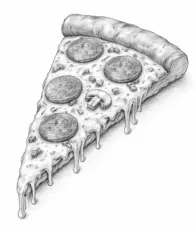
Pizza slice pencil drawing
2. 🍌 Banana SUPER EASY
Why it's perfect for beginners: Bananas have a simple curved shape that helps you practice smooth lines and basic shading.
Pro tip: Draw two parallel curved lines, then connect the ends. Add the stem and some brown spots for realism. Shade one side darker to show dimension.
Skill learned: Curved lines and creating depth with shading
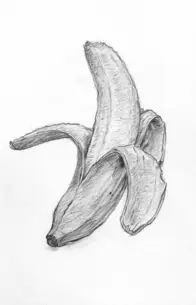
Banana pencil drawing
3. 🍩 Donut SUPER EASY
Step-by-step: Draw two circles, one inside the other. Add wavy lines on top for icing. Draw small ovals for sprinkles. Shade the inner circle darkest.
Fun variation: Try different icing patterns or make a whole donut box!
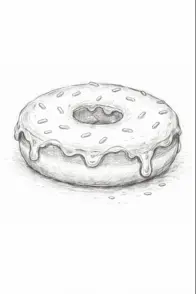
Donut pencil drawing
4. 🎂 Birthday Cake EASY
How to draw: Start with two stacked rectangles for layers. Add a wavy line on top for frosting. Draw candles (rectangles with flame shapes). Add details like swirls and decorations.
Skill learned: Layering and adding decorative details
5. Your Favorite Food
🐱 Animals (Starting Simple)
Breaking down the animal's feature's into basic geometric shapes can help remove some of the complexity of drawing animals. The material contained in these selections includes the easiest forms of drawing animal faces to the complete body of animals.
6. 🐱 Cat Face EASY
Why cats are great for beginners: Cat faces are wonderfully forgiving. They're symmetrical and use simple shapes that even young children can master.
Step-by-step guide: Draw a circle for the head. Add two triangles on top for ears. Draw two dots for eyes, a small triangle for the nose, and a "w" shape for the mouth. Add three lines on each side for whiskers.
Level up: Once comfortable, try adding fur texture with short, quick strokes around the outline.
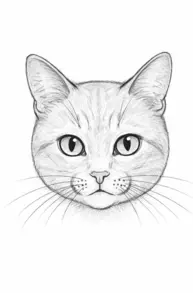
Cat face pencil drawing
7. 🐰 Bunny EASY
How to draw: Start with a circle for the head. Add two long oval shapes for ears. Draw a smaller circle below for the body. Add dots for eyes, a triangle nose, and a cotton ball tail.
Personal touch: Bunnies look adorable with rosy cheeks (light pink circles on each side)
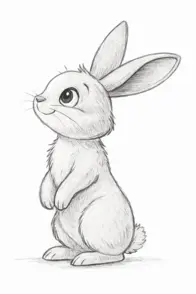
Bunny pencil drawing
8. 🐯 Tiger Face EASY
Step-by-step: Similar to the cat, but add black stripes across the face. Make the face slightly wider. Add bigger eyes and more prominent whisker dots.
Tip from experience: Don't worry about making the stripes perfect. Real tiger stripes are irregular, so yours should be too!
9. Fish
10. Bird
11. Spider
12. Crab
13. Mouse
14. Hippo
15. 🦉 Owl EASY
Why owls are beginner-friendly: Owls are mostly circular shapes stacked together, making them surprisingly easy to draw while looking impressive.
Quick guide: Draw a large circle for the body. Add two circles inside for eyes. Draw a small triangle between the eyes for the beak. Add ear tufts (triangles) on top. Draw wing shapes on the sides using curved lines.
16. Worm
17. Fish
18. Bug
19. Worm with Face
20. Dog
21. Dragon
22. Your Favorite Animal
🎨 Stuck on What to Draw Next?
Use our FREE Drawing Ideas Generator to get instant inspiration tailored to your skill level!
Get Random Ideas →👾 Creatures & Fantasy
These imaginative subjects are perfect for beginners because there's no "wrong" way to draw them. Let your creativity run wild!
23. 👾 Three-Eyed Monster EASY
Why monsters are amazing for beginners: There's no reference to match, so you can't make a "mistake." This builds confidence while teaching you to trust your creative instincts.
Creative approach: Draw any blob-like shape for the body. Add three circles for eyes. Draw sharp teeth or a goofy smile. Add horns, tentacles, or spikes. Make it silly, scary, or cute – it's YOUR monster!
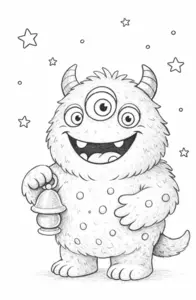
Three eyed monster pencil drawing
24. 😱 Scary Monster EASY
Elements that make it scary: Sharp angles, pointed teeth, dark shadows, and asymmetrical features.
Drawing tip: Use jagged lines instead of smooth curves. Add lots of teeth and narrow, intense eyes.
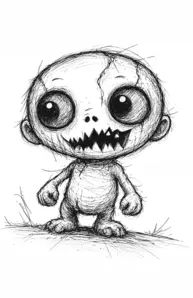
Scary monster pencil drawing
25. 🦄 Unicorn EASY
Simple method: Start with a horse head shape (or just a circle if you're really beginning). Add a cone/spiral horn in the center of the forehead. Draw a flowing mane with curved lines. Add magical details like stars or rainbows around it.
Pro tip: You don't need to draw the whole unicorn. A unicorn head is just as magical and much easier!
26. Robot
27. Astronaut
🏠 Objects & Scenery
These drawing ideas for beginners help you understand perspective and spatial relationships while creating recognizable subjects.
28. 🏠 Simple House EASY
Basic structure: Draw a square or rectangle for the main house. Add a triangle on top for the roof. Draw a rectangle for the door and squares for windows. Add details like a chimney, path, or fence.
Skill learned: Basic perspective and architectural elements
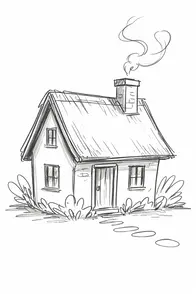
Simple house pencil drawing
29. ⛵ Boat EASY
Simple steps: Draw a curved line for the bottom of the boat (like a smile). Add vertical sides. Draw a triangle for a sail. Add a mast (vertical line) and flag on top. Draw wavy lines below for water.
30. 🌳 Giant Tree EASY
How to make it look giant: Use two vertical lines to represent the trunk of the tree, but make the lines wider at the base. After your trunk, create a number of fluffy, cloud-like shapes representing the leaves. Write one or two lines for the textures of the trunk. And to complete your sketch of the tree, add a few lines of grass at the base of the tree. The more substantial the crown (branches and leaves) of the tree, the more impressive it will appear!
31. Leaf
32. Sunrise
33. Star
🎭 Personal & Imaginative Subjects
These subjects encourage you to draw from memory and imagination, developing your unique artistic voice.
34. 👶 Baby Face EASY
Key features: Babies have large heads compared to their bodies, big round eyes, and soft features. Draw a large circle for the head. Add huge eyes (circles) lower on the face than you'd expect. Small nose and mouth. Add a few strands of hair or a cute hat.
What makes it look like a baby: The proportions! Big head, big eyes, small features.
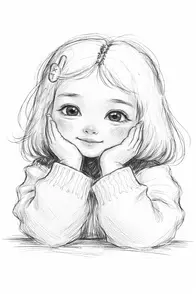
Baby face pencil drawing
35. 👨👩👧👦 Family Portrait EASY
Beginner approach: Don't aim for perfect likeness. Draw simple stick figures with circles for heads. Differentiate family members by height, hair style, and clothing. Add characteristic features (glasses, favorite colors, etc.).
Personal note: I always tell my students that family portraits are about love, not perfection. Your family will treasure it regardless of technical skill!
36. 📚 Favorite Book Character EASY
Why this is valuable: Drawing characters from books helps develop your ability to visualize and interpret descriptions into images.
Tip: Focus on one defining feature that makes the character recognizable (Harry Potter's glasses and scar, for example).
37. Something You Love
38. Fairy Forest
39. Night Walk in Paris
40. A Far Away Place
💡 Essential Tips for Drawing Success (From My Teaching Experience)
After teaching thousands of beginners, these are the tips that make the biggest difference:
- Start with Light Lines: Press gently with your pencil at first. You can always darken lines later, but erasing heavy lines damages the paper and your confidence.
- Draw What You See, Not What You Think You See: This is the hardest concept for beginners. Your brain has shortcuts for how things "should" look. Train yourself to actually observe.
- Use References Without Guilt: Professional artists use references constantly. Looking at photos or real objects while drawing isn't cheating, it's learning.
- Practice the 20-Minute Rule: Draw for at least 20 minutes daily. Short, consistent practice beats occasional marathon sessions.
- Keep Everything You Draw: Date your drawings. Seeing your progress over weeks and months is incredibly motivating.
- Join a Community: Share your work on Instagram, Reddit, or local art groups. Feedback and encouragement accelerate learning.
- Embrace "Bad" Drawings: Every artist has created thousands of drawings they're not proud of. Each one taught them something.
🎯 How to Use This List Effectively
Don't feel pressured to draw all 40 ideas in order. Here's how I recommend approaching this list based on your goals:
If You Are an Absolute Newbie at Art Drawing:
Pizza, bananas, and donuts create a forgiving way to learn about shapes. After you learn how to draw them and build your confidence, you can move on to easy animals such as cats and bunnies.
If You Want to Win Quickly:
Try learning how to draw fantasy creatures such as monsters, aliens, and robots because there really isn't a right way to learn how to draw them. When you draw these types of things, you will feel successful before you even finish the drawing and quickly build up your confidence.
If You Want to Develop Real Skills:
Systematically go through each category because they teach different basic drawing skills. The food category teaches you about shapes. The animal category teaches you about proportion, and the scenery category teaches you how to use perspective in your drawings.
If You Are Drawing with Children:
Let them pick from the list of drawings. Because they are excited to be learning, they will have a wonderful time; and you, as a teacher, will also be involved in the learning process. Some of my best teaching experiences were when I drew alongside my students instead of just teaching them.
🚀 What to Do After You've Tried These drawing ideas for beginners
Once you've drawn several items from this list, you're ready to level up. Here's what I recommend:
- Combine Elements: Draw a cat riding a boat, or a house in a fairy forest. Combining simple elements creates more complex, interesting drawings.
- Add Backgrounds: Don't let your drawings float in white space. Add simple ground lines, skies, or patterns behind them.
- Experiment with Style: Try drawing the same subject in different styles (realistic, cartoon, minimalist).
- Study One Subject Deeply: Pick your favorite animal or object and draw it 10 different ways. This focused practice builds real expertise.
- Try Different Tools: Once comfortable with pencil, experiment with pens, markers, or digital drawing apps.
❓ Beginner Drawing Ideas FAQ
"Do I Need Expensive Materials?"
Absolutely not. I have seen countless students create amazing artwork with only basic art supplies from the school store: a standard HB pencil, plain printer paper, and a standard sized eraser are all you need to learn how to draw. Only update your art supplies after at least a couple of months of drawing consistently.
"How Long Until I'm Good?"
Honest answer: You should notice a dramatic improvement in your drawings after 2-3 weeks of daily practice. You will achieve a level of mastery within 6-12 months, and ultimately a level of expertise will take years. The secret is you don’t have to reach a level of mastery in order to find enjoyment in drawing or to create something you will feel accomplished about.
"What If My Drawings Look Bad?"
They're supposed to! All professional artists keep “bad” drawings in their sketchbooks. The only difference is that they continue drawing, and you’re just beginning. Your early drawings do not represent failure…they are the basis for your work in the future.
"Should I Take Classes?"
Eventually, yes. But to start, use the free resources available (like this website) and Youtube tutorials. Only after you’ve practiced for at least 1-2 months, and are sure you want to continue with your newfound hobby, will a class or course provide greater benefit. By that time, you have developed some basic skills and can begin developing your craft through training.
🎨 Ready to Start Drawing?
Use our Random Drawing Wheel to pick your first subject and begin your art journey today!
Spin the Wheel →🌟 Your Drawing Journey Starts Now
For your learning, I've compiled a list of 40 drawing ideas. Each idea has been chosen because it's simple enough for a beginner to understand and execute, as well as having support and advice on how best to use those ideas. To get started with your first drawing from the list, select ONE drawing from the list and draw for 10 minutes. Do this NOW! Don't put it off until later.
Having been an educator in the art field for many years, I have learned that the students who excel at their craft are not the most naturally gifted. Rather, these students are the ones that have committed themselves to start drawing, and to keep doing so until they master their skills. Every professional artist you admire has been where you currently are, staring at a blank page and feeling a bit nervous about making that first mark.
Remember drawing is a 'skill' rather than a 'talent', and with practice any individual can gain the skills necessary to create great images. You do not have to be a "gifted" or "natural" artist to draw images that you are proud of; you just have to begin creating them. So go ahead and draw your FIRST image from the 40 drawing ideas!
What will you draw first?
🎯 Need More Inspiration?
If you want more inspiration, check out our complete guide to simple easy drawing ideas step by step with pictures.
OR Get unlimited drawing prompts with our FREE generator. Perfect for daily practice!
Generate Ideas Now →